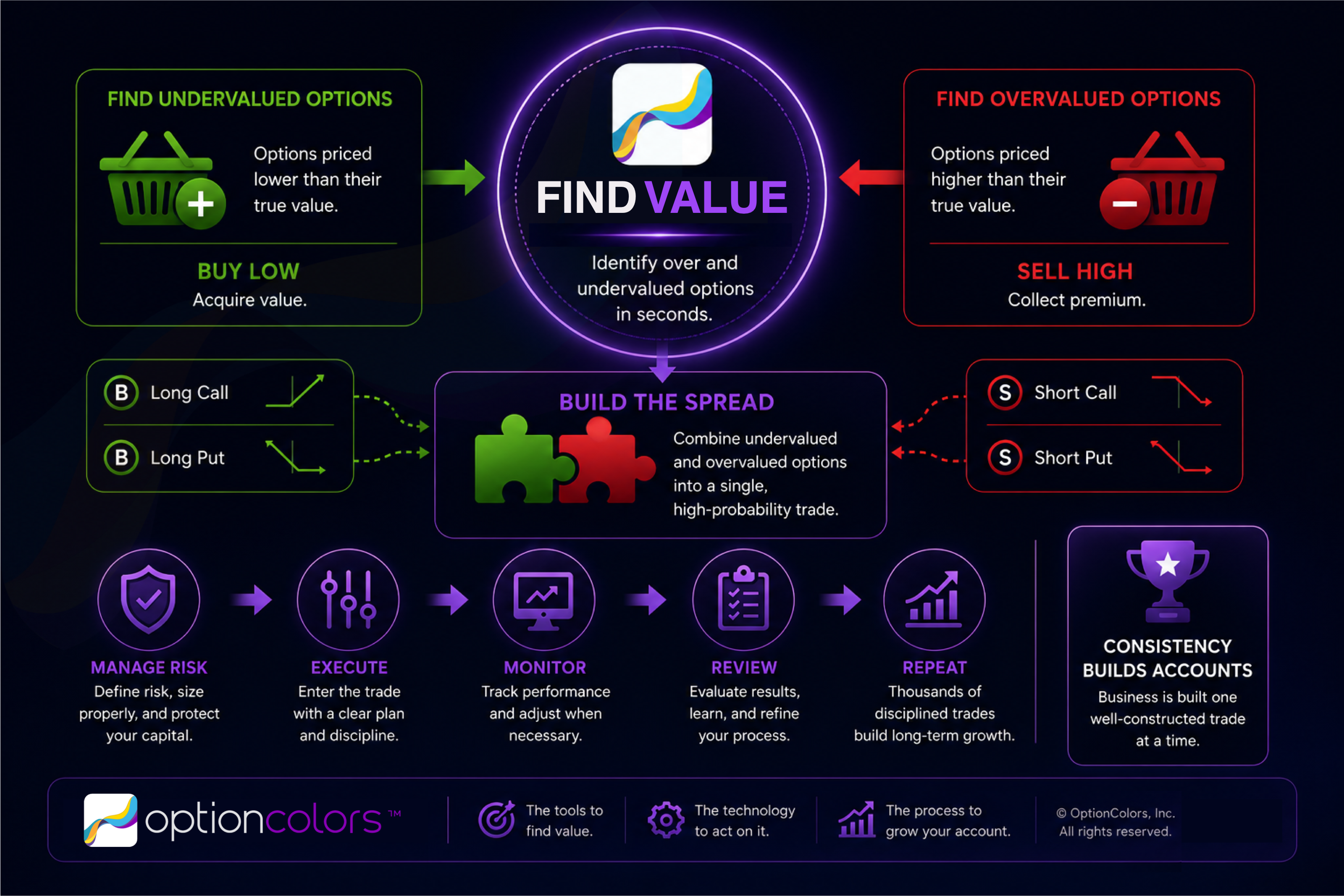
Options are complex financial instruments. Their prices are influenced by time, volatility, movement in the underlying asset, interest rates and the interaction of multiple risk measurements. The business principle behind trading them, however, is much simpler: acquire value at a favorable price, manage the associated risk and sell when that value is realized.
Retailers, manufacturers, wholesalers and investment firms all depend on some version of the same economic process. They identify an asset or product, determine what it is worth, acquire it at a favorable price and attempt to sell it at a higher price. A business that consistently reverses that process—buying expensive inventory and selling it cheaply—cannot remain successful for long.
The Business Model Never Changes
A grocery store compares suppliers before stocking its shelves. A car dealership evaluates auction prices before purchasing inventory. A manufacturer compares the cost and quality of raw materials before selecting a vendor.
In each case, the business must know whether the price it is paying is reasonable. Without that information, it cannot determine whether enough potential value remains to justify the transaction.
Options traders face the same requirement. Before buying or selling an option, the trader should understand how its price compares with relevant alternatives, its own historical behavior and the volatility environment in which it is trading.
How Does an Options Trader Buy Low and Sell High?
In a conventional business, the price of inventory may be compared across wholesalers or suppliers. Options require a more sophisticated comparison because two contracts that appear similar can carry materially different levels of implied volatility, probability, time exposure and sensitivity to movement in the underlying asset.
Buying low does not simply mean purchasing the option with the lowest dollar premium. A low-priced option can still be expensive relative to its probability of success, expected movement or comparable contracts.
Likewise, selling high does not necessarily mean selling the option with the largest premium. A high premium may exist because the seller is assuming unusually large volatility, event or directional risk.
The relevant objective is to identify relative value: options that appear inexpensive or expensive after their risk characteristics and market context are considered.
You Cannot Buy What You Cannot See
A business cannot intentionally purchase favorable inventory unless it can first locate and evaluate it. The same limitation applies to options trading.
Most trading platforms display option chains, bid and ask prices, Greeks and theoretical payoff diagrams. Those measurements are useful, but they may provide relatively little guidance about whether one option is expensive or inexpensive compared with another.
A trader may therefore choose a strike because it appears attractive on a payoff diagram, or choose an expiration because its premium seems appealing, without seeing the underlying relative-value relationship.
When important pricing relationships remain difficult to locate, traders may repeatedly purchase comparatively expensive options or sell comparatively inexpensive ones without realizing that the trade began with a pricing disadvantage.
A business-oriented process
What disciplined traders evaluate
- Relative implied volatility
- Strike and expiration relationships
- Expected movement and probability
- Liquidity and execution cost
- Risk relative to potential reward
An incomplete process
What can weaken consistency
- Choosing trades from premium alone
- Relying exclusively on payoff diagrams
- Ignoring volatility relationships
- Treating every trade as an isolated decision
- Entering positions without a defined process
Options Are the Inventory
A useful way to think about an options position is as inventory. The trader acquires one set of risk exposures and may sell another set through a spread.
A vertical spread, calendar spread, butterfly or volatility trade is not merely a collection of option legs. It is a structured exchange of value and risk. Each contract contributes its own price, volatility, probability and sensitivity profile.
The quality of the completed spread therefore depends in part on the value embedded in its individual components. A visually appealing strategy can still be poorly priced when the trader buys comparatively expensive options or sells comparatively inexpensive ones.
Consistency Builds Accounts
Sustainable businesses are rarely built from one exceptional transaction. They grow through the repeated execution of a sound process.
Options trading should be approached in the same way. One profitable trade does not establish a reliable business, and one losing trade does not necessarily invalidate a sound process. What matters is whether the trader can apply a disciplined framework consistently across many decisions.
That framework should define how opportunities are located, how prices are compared, how risk is measured, how positions are sized and how trades are managed after entry.
Consistency does not eliminate losses. Every business accepts some transactions that perform below expectations. The purpose of a repeatable process is to reduce avoidable mistakes and improve the quality of decisions over time.
The Cost of Operating Without Pricing Visibility
Imagine operating a retail store without knowing what competing suppliers charge for inventory. The store owner might repeatedly overpay, leaving too little margin to cover operating costs or compete effectively.
Options traders can encounter a similar problem when pricing information is presented without sufficient context. A contract may appear inexpensive because its premium is small, while its implied volatility is high relative to comparable options. Another contract may appear expensive in dollar terms while providing comparatively favorable exposure.
Without tools that organize and compare this information, traders may spend substantial time searching manually or may never see the relevant relationship at all.
Building Spreads Around Relative Value
Once relative value is identified, the next step is to determine whether it can be incorporated into a trade that fits the trader's outlook and risk limits.
An undervalued option is not automatically an appropriate purchase. An overvalued option is not automatically an appropriate sale. Direction, probability, volatility, liquidity, time horizon and portfolio exposure must still be considered.
The business advantage comes from combining these measurements rather than evaluating them in isolation. A trade should reflect both a market thesis and a pricing thesis.
How OptionColors Supports the Process
OptionColors is designed to make relative-value information more visible and actionable. The platform extracts key relationships from the options market and presents them in a format intended to help traders compare contracts, expirations and potential spreads more efficiently.
Rather than beginning with a strategy name and searching only for contracts that fit it, traders can examine where value may exist and then evaluate whether an appropriate spread can be constructed around that information.
The objective is not to eliminate judgment or promise profitable outcomes. It is to improve the information available to the trader so that buying, selling and spread construction can be approached as parts of a disciplined business process.
A Business Built on Better Decisions
Options trading may be technically complex, but the underlying business objective remains familiar: identify value, acquire it at a favorable price, manage the risk and repeat the process consistently.
Traders who cannot see relative value are forced to make decisions with incomplete information. Traders who can evaluate pricing relationships have a stronger foundation for determining what to buy, what to sell and how to structure the trade.
The long-term goal is not simply to find more trades. It is to build a more informed, measurable and repeatable decision-making process—because consistency is what turns isolated transactions into a business.